Why Futures in Draft matters to us all
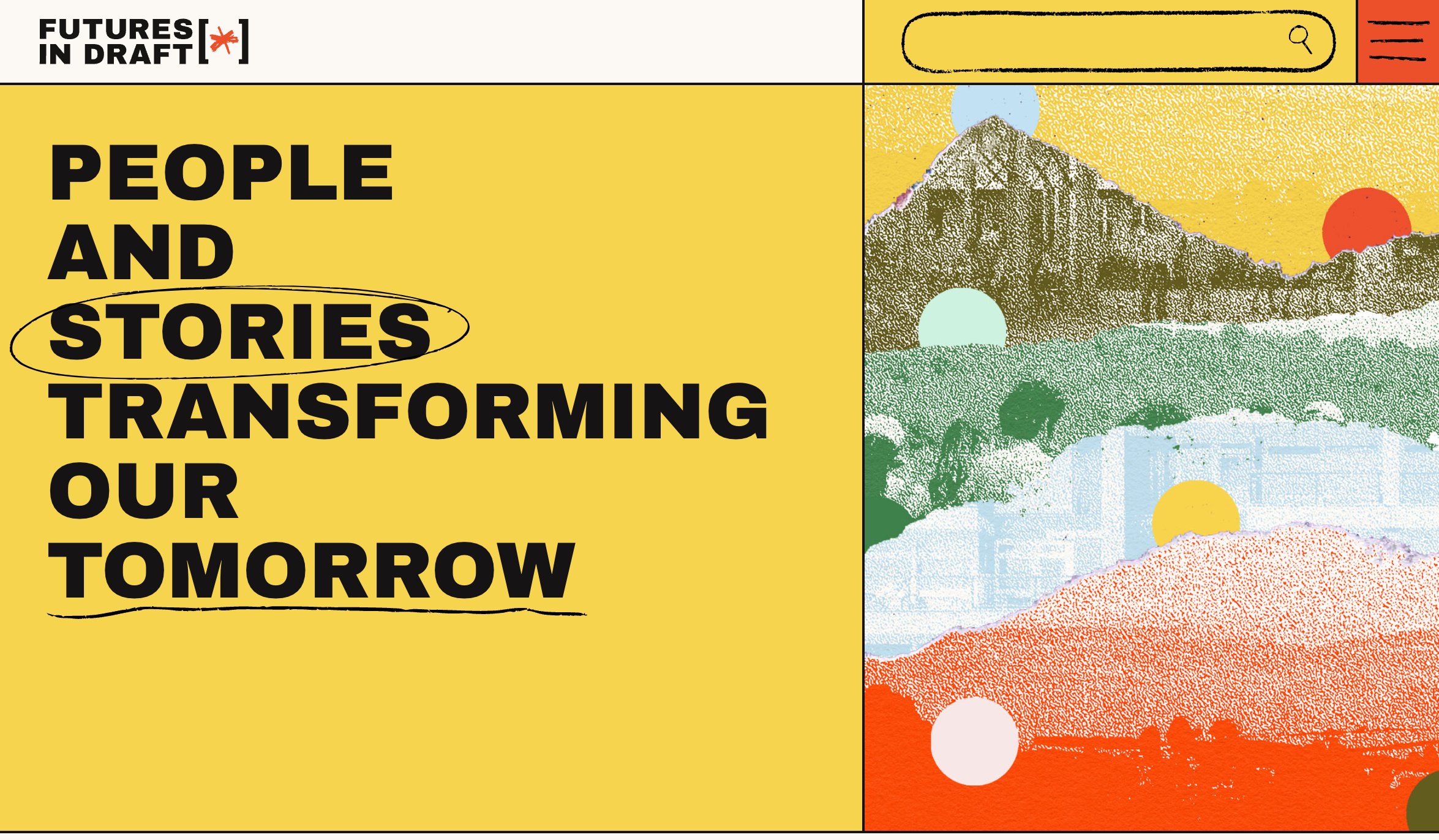
After nearly two years of collaboration Storythings and JRF are launching Futures in Draft — a new platform sharing the people and stories transforming our tomorrow.
The work of JRF’s Emerging Futures team is vital in speeding up a transition to a more equitable world. For nearly 2 years, Storythings has worked with Emerging Futures and JRF’s Communications and Public Engagement team to understand how the growing number of movements and individuals working to build better futures might be better able to see themselves in each other, to help them connect the dots and grow the expanse and influence of their work. That work launches today as Futures in Draft, a platform for people and stories transforming our tomorrow. Here, Anjali gives us a behind-the-scenes look at what went into making it a reality.
Futures in Draft
This is the story of how Futures in Draft came to be: a platform dedicated to amplifying the voices of people and collectives doing the quiet, critical work of imagining and building more just futures.
In 2024, Storythings began working with the Emerging Futures team at JRF. We started with audience research — speaking to around a dozen people across their network: collaborators, funders, grantees, and people with lived experience. We wanted to understand what kind of content would actually be useful for them, not just well-intentioned.
We also analysed peer organisations, looking for patterns in tone, language, storytelling formats, and purpose.
What emerged was a set of insights that felt both challenging and clarifying:
“Often what's missing from the conversation is people that are practically doing stuff in communities. I think there's a lot of people just talking about stuff and not actually, like, getting down to the work. And then there are some people who are under-resourced and stretched too thinly. And the people actually doing the work are often just doing it without being able to get involved in any of the thinking stuff.”
“Because we are disconnected, the problem looks different from every perspective, but it's the same problem. And so a lot of the work is really about translating that and helping people understand that this is actually the problem and we can actually address it together.”
“The way in which ideas are projected, and produced and presented, is really important. You can have brilliant ideas that can, sort of, disrupt that system from a sort of theoretical point of view. But in the end, you're dealing with the vested interests of hugely powerful institutions, whether that's political parties, Parliament itself, policy institutions like banking. And in the end, it's not actually the quality of ideas that changes the direction of travel.”
“I don't think we should change the language, but I think there's a gap between how are we helping people understand what we mean? And a lot of the blogs and the outputs I think really suit an audience that already understands that language and for lots of people is really isolating.”
"It's something else. It's a change in something that forces their vested interest to change, and at that point they then grasp the new ideas. And so if you've got some good ones going around, then there's a good chance they get picked up.”
By the end of this phase, one thing was clear: what was missing wasn’t ideas. It was infrastructure. Narrative infrastructure. A way for people doing the work to find each other, learn from one another, and feel less alone.
For more on the audiences and the model of work that Emerging Futures are keen to engage with, please read these posts on a new model for systems transformation by the Onion Collective.
Why narrative infrastructure matters
Lately, I’ve been reading 2 books whose themes intersect almost too neatly with this moment.
One is Sapiens by Yuval Noah Harari, which traces how humans have systematically reshaped — and often destroyed — the lands and societies they’ve conquered over millennia. The other is Empireworld by Sathnam Sanghera, a piercing examination of the British Empire and its enduring legacies: colonialism, racism, and economic inequality on a scale that remains difficult to fully grasp.
I found myself thinking about both books as we worked on launching Futures in Draft.
Yes, a great deal has changed for the better since the era of the Neanderthals. But for many people — particularly those with roots in the Global South — certain realities remain stubbornly familiar: anti-immigration sentiment, human rights violations, environmental degradation, casteism, systemic exclusion. The specifics differ across time and place, but the pattern is unmistakable.
It’s hard to claim there’s a single thread running through all the challenges we face. But there is something that connects them: the sense that our systems are not working for the majority of people — and that we deserve better. But how do we change the systems we have if we can’t describe what we want because we can’t see them clearly enough?
Trust in the media has also been steadily eroding. We’re inundated with news every day — much of it bleak, alarming, and exhausting. The situation is expressed by this, from the 2026 Journalism, Media, and Technology Trends and Predictions 2026 report by the Reuters Institute at the University of Oxford:
"Declining engagement for traditional media combined with low trust is leading many politicians, businessmen, and celebrities to conclude that they can bypass the media entirely, giving interviews instead to sympathetic podcasters or YouTubers. This Trump 2.0 playbook — now widely copied around the world — often comes bundled with a barrage of intimidating legal threats against publishers and continuing attempts to undermine trust by branding independent media and individual journalists as ‘fake news’. These narratives are finding fertile ground with audiences — especially younger ones — that prefer the convenience of accessing news from platforms, and have weaker connections with traditional news brands."
For many, this constant stream of alarming news doesn’t inspire action; it breeds paralysis. We need a way for the right narratives to be seen, shared and spread, to stop the feeling of overwhelm and encourage hopeful action.
I’m reminded of something Douglas Rushkoff said in a recent interview with Columbia Journalism Review on the Journalism 2050 podcast. He was asked what hope remains for journalists, writers, and community organisers in a world saturated with misinformation, AI-generated content, and hate. His response is worth quoting in full:
"You know if you don't trust the local news because it's owned by somebody working for the administration. It's like look outside, look into the faces of people. Look at the old person sitting on the bench. Is anyone taking care of them? Sit next to them and get a sense of what's going on."
In other words: let people tell you what it feels like to live where they live. Start there.
Making futures work feels like it belongs to everyone
Coming into this project from outside the ‘alternative futures’ world, I’ll be honest: at times, I felt alienated. The language could feel dense. The ideas heavy. The tone, unintentionally, exclusive.
The work is heavy. But when it’s communicated in a way that feels like it’s only meant for insiders, it risks deepening the very divisions it seeks to heal — and making change harder, not easier.
From the start, we knew exclusivity was something we actively wanted to avoid. We wanted people doing the work to talk about it in their own words. We wanted lived experience — not abstract theory — to lead. We wanted people to recognise themselves in one another, across geography, class, and background. We wanted no one to feel alone in caring.
Because the truth is: the work of building better futures is already happening. It has been for a long time. But if we want to move faster — and further — we have to move together.
From insight to infrastructure
With the clarity that came from the initial piece of audience research, we worked to prototype a handful of content formats that could hold these stories — formats shaped by lived experience rather than institutional voice. That gave us the opportunity to actually see what these stories might look like, and the effort it would take to shape them into what we wanted. When we got the go-ahead to build Futures in Draft, the real work began.
From January 2025, Storythings spent 6 months developing the project’s editorial strategy. We asked hard questions about what stories weren’t being told - and why. What was its editorial mission? Who was it for? What was its tone of voice? What kind of stories could we tell that were not already being told? What kind of contributors did we hope to commission? Why would people want to share these stories?
In May 2025, we brought on a Managing Editor and an Impact and Engagement Strategist, both deeply rooted in this ecosystem. Shortly after, we realised something crucial: if this platform was truly going to represent the field, it needed guidance from the field itself.
So we formed an advisory group of 8 people with lived experience and deep expertise. Alongside them, we recruited a focus group of 29 younger people — many at the edges of the work, starting their careers in academia, non-profits or fieldwork, but deeply invested in its future. They tested language, formats, and ideas, helping us ensure the work felt accessible without being diluted. On top of this, we had a dozen or so one-to-one conversations with members of the ecosystem to ensure we were listening to their thoughts and concerns about such a large-scale editorial project, and 70+ responses to a public survey inviting anyone working in the alternative futures field, or with an interest in it, to contribute their thoughts.
Their feedback shaped everything.
Commissioning with care
Throughout the second half of 2025, we commissioned and edited 23 stories across 5 formats, including a podcast. From the outset, we prioritised BIPOC (Black, Indigenous and People of Colour) writers and creatives embedded in this work — not as a diversity checkbox, but because lived experience fundamentally changes how stories are told.
As a result:
- 97% of contributors are from the global majority
- 87% identify as women or non-binary
- 57% are based outside London
- contributors span the UK, Thailand, Mexico, the Philippines, Trinidad and Tobago, and the US.
Building together, imperfectly
From naming the project to shaping the brand, from early drafts to final edits, Storythings and JRF worked hand in hand — with advisory members, focus groups, and the wider ecosystem. We listened. We deliberated. We adjusted.
It wasn’t always smooth. But we learned that communication matters more than perfection, that intention needs to be shared — not assumed — and that done really is better than perfect when the work is urgent.
A soft launch in January helped us refine what we could, after a two-week testing period that gave us insights on how our audience understood the messaging, the stories, and the user journey on the platform. We used February to make the changes we could. Then, following wise advice from our advisory group, we chose to stop waiting for certainty.
And so, here we are
Today, we’re launching Futures in Draft with pride, and a little trepidation.
It’s a place for inquiry. For worldbuilders. For people who sense that something isn’t working, and want to imagine — and practice — something better.
As one early research participant put it:
Basically, the question is: if you care about the world, then this conversation is for you.
We hope you’ll read the stories, listen to A World With, subscribe to our newsletter, follow us on Instagram and LinkedIn, share with friends, colleagues and family, and tell us what resonates and what doesn’t. This is not a finished thing. It’s a living one.
And if some of these stories help you feel less alone, or more connected, or more hopeful — then we’ll have made a difference. Because better futures are built when many voices finally hear each other.
About the author
Anjali Ramachandran is a Director at Storythings, a B Corp-certified content production agency that helps organisations stay human in an increasingly AI-dominant world. She is the co-founder of women-in-tech network Ada’s List, now part of the global Tech Ladies community, and is a trustee of Wasafiri, the UK’s leading magazine for international contemporary writing. At Storythings, she has been leading their work with JRF over the past 2 years.

This reflection is part of the imagination infrastructures topic.
Find out more about our work in this area.