Helping grassroots movements in Scotland thrive
We look at how funders in Scotland can help people organise, connect, recover, and build power on their own terms — and the redistribution of wealth and power that will need.
Executive summary
This report follows an open call for proposals to help JRF progress our work in grassroots organising and community building, and in particular how that work might be supported in Scotland. We appointed the collective, a Scottish-based group of facilitators, researchers and activists, to carry out that work for us. This report is the culmination of numerous discussions with people and groups all over Scotland, over a period of months — we are very grateful to Kate, Iffat, Megan and Talat for their work.
This year, we'll consider JRF's response to the evidence and detailed findings of their work. There is much food for thought, not just for JRF, but anyone working in or funding this area — JRF's work going forward is much more likely to succeed if we are able to find partnerships giving us potential to invest in this area.
There are a number of different ways in which funders, wealth holders and larger organisations could provide meaningful forms of support to the grassroots organising and movement-building ecosystem in Scotland. However, this report recommends that JRF collaborates with others to explore funding and support mechanisms across 3 specific strands:
- Community, solidarity and vision: support to groups and organisers to create and run safe(r) spaces, connect and learn across movements, build strategies and envision alternatives. This could include peer-led incubation support for growing groups and movements, and support to plan long term.
- Safety and collective care: help provide access to external legal, wellbeing and security support and hardship funds, and support to groups and organisers to build tactics and skills for maintaining collective wellbeing and safety.
- Basic resources: for ‘outside-game’ organisers in particular (who challenge power from outside formal institutions), access to untied cash for the basics of organising, and access to fiscal and digital infrastructure that allow groups to remain in informal structures.
Across all of these strands, a focus on supporting infrastructure that specifically supports (rather than includes support for) racialised communities, migrant communities, disabled communities, queer communities and young women to self-organise, would help fill a major gap in what is available in the ecosystem in Scotland.
However, there is no one singular method or model that could provide the support needed: the living breathing ecosystem demands an equally adaptive, and deeply relational approach. Scotland also lacks many infrastructure or intermediary organisations that would be able to hold this work at scale, meaning support will likely need to continue to flow through a diverse mix of smaller, often activist-led groups.
Any intervention should be about contributing to the conditions that allow people to organise, connect, recover, and build power on their own terms. And about the redistribution of wealth and power that this requires.
1. Introduction
There is an extremely vibrant ecosystem of grassroots organising and movement-building across Scotland:
Building collective power and inspiring activity and initiative in people to meet their own needs through collective action.
Survey respondent, Glasgow
Groups are self-organising across a wide range of social justice issues, including housing, migration, anti-racism, anti-fascism, disability justice, climate, workers’ rights (including sex workers' rights), trans rights and Palestine solidarity, often recognising how these struggles are linked. They are also organising in a huge variety of ways, from building and nourishing communities and creating spaces of care, safety and belonging, often by and for communities on the margins, through taking to the streets, door-knocking, demonstrating, disrupting and direct action.
Around this organising is a strong but amorphous web of support, including informal systems of peer-to-peer support, shared resources and political education, as well as a growing network of progressively-minded funders and larger charities who are keen to find new ways to support movement-building. Activist-led collectives, ‘radical’ social spaces, wellbeing spaces, community kitchens, and growing numbers of community land takeovers (particularly in rural areas of Scotland) are providing a backbone of space, food, learning and solidarity that is making organising possible.
However, this ecosystem is also fragile, and increasingly under threat. As elsewhere in the UK and the world, in Scotland we are currently facing an increasing backlash against progressive social justice movements and organising, and the rise of far-right groups in both number and prominence (Sijstermans, 2025). Many activists involved in this research report increasing experiences of racism, racial violence and transphobia and feeling less safe participating in visible actions. Some organisations also expressed fear of reprisals and are taking steps such as changing how their group’s name appears publicly.
The current UK Government is also taking increasingly authoritarian approaches to protest and public order, and recent transphobic court rulings have further embedded fear and self-censorship in feminist and LGBTQ+ spaces. Further, the deepening cost of living crisis following decades of austerity is affecting who is able to volunteer their time. Many public and community ‘third’ spaces have disappeared, and community groups are increasingly pressured into service delivery to fill gaps, leaving little capacity and energy for organising and pushing for systemic change.
This report forms part of the collective and JRF's project on how funders can meaningfully support grassroots organising and movement-building in Scotland, at a time when space for this kind of work appears to be receding. The paper explores some of the challenges and strengths of grassroots organising and movement building in the current context, and looks at ways in which the ecosystem might be supported to thrive. The report is a result of conversations, workshops and a survey with activists, organisers and supporting organisations across Scotland, including people active across multiple, interlinked social justice issues. An expanded version of this report, with greater depth on each area, is available on request.
2. Definitions and types of organising
Power from the people, for the people.
Survey respondent and organiser
We’ve kept our definition of ‘grassroots organising and movement building’ deliberately broad for this piece of work, in order to resist imposing narrow ideas or false boundaries about what counts as ‘real’ political action, and instead to try and capture the spirit of what’s happening in Scotland. However, from our conversations with organisers, activists and support organisations, it is clear that there are some central shared beliefs about what constitutes the essence of grassroots organising and movement-building, namely that it is:
- bottom-up, self-organising, community-led and rooted in lived experience: this is the primary reason that grassroots organising is trusted, effective and capable of responding quickly and authentically to harm and injustice
- building collective power and redressing entrenched power imbalances, particularly for communities that are marginalised or excluded from decision-making
- fundamentally relational and about building solidarity, belonging and connection as core aspects of building power
- change-oriented: taking action to shift power, improve material conditions, challenge unjust systems or bring to life new ones.
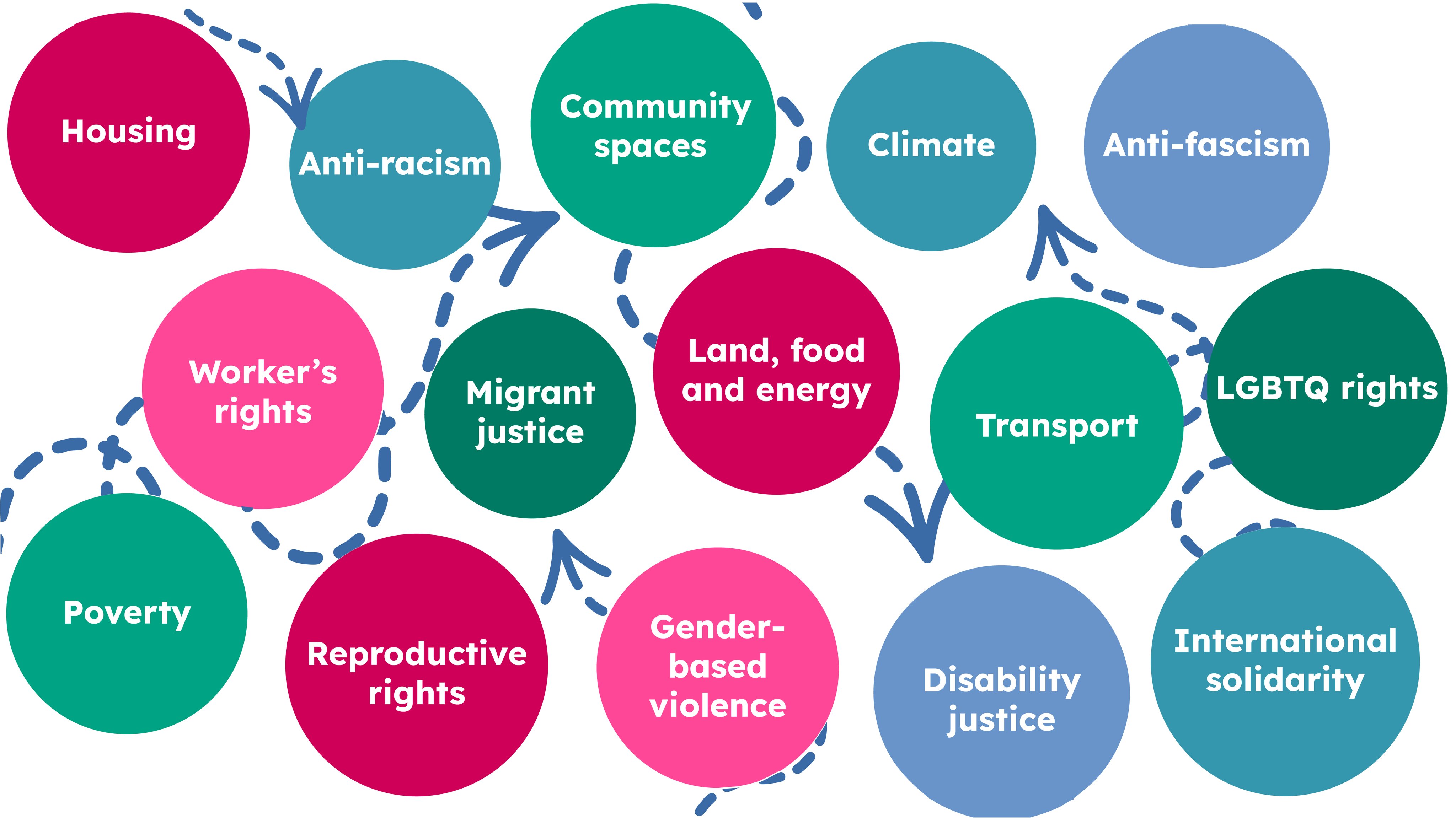
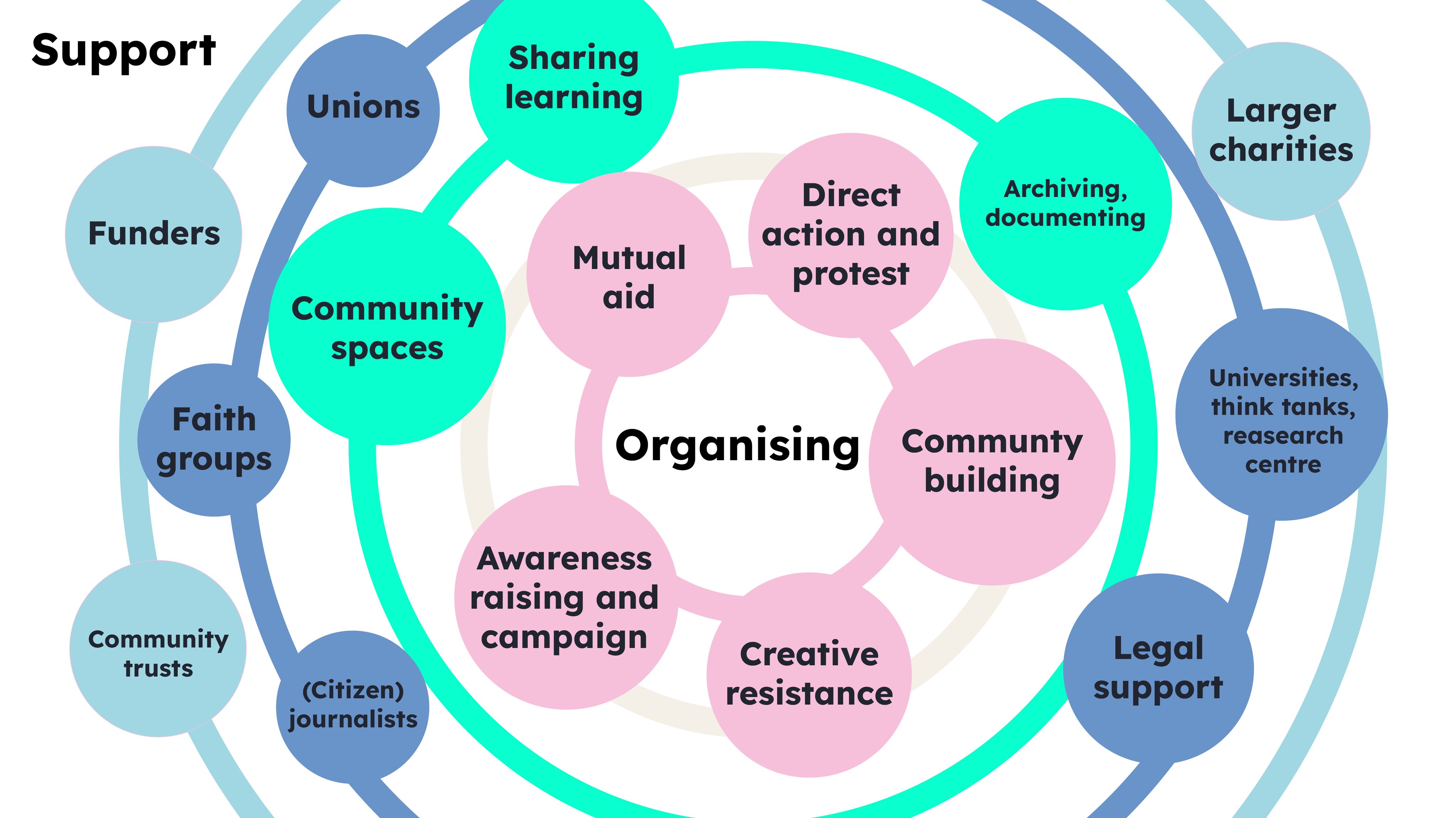
We also took an inclusive approach to what might fall under the header of ‘social justice’. We spoke with people organising across a wide range of issues: from housing, migration, anti-racism, anti-fascism, gender-based violence and disability justice to climate, land rights, trans rights, Palestine solidarity, alternative economies and workers’ rights including sex workers' rights. Lots of people we spoke to were active across issues, often driven by big-picture, progressive, anti-capitalist ideals, in particular organising in response to climate and economic crises and racial injustice.
We identified 4 main types of organising and movement building across Scotland. These are not mutually exclusive, and most groups operate across more than one of these categories, moving between them depending on context, capacity, risk, and the kind of change they are trying to achieve.
- Community building and community nourishment: focuses on fostering connections, relationships and a sense of belonging, as well as responding to communities in need. Examples of activities include self-organised community solidarity and wellbeing spaces, community meals and community kitchens, peer support and befriending, cultural gatherings, community education spaces and mutual aid groups.
- Base building and mobilising initiatives: focuses more explicitly on growing the numbers of people engaged on a particular issue or around a shared set of demands, whether locally or nationally. Common activities include door-knocking and neighbourhood organising, petitions and list building, workplace and tenant organising, leadership development and political education, and building issue-based coalitions and alliances with other groups.
- Outside-game organising: centres on efforts that challenge power from outside formal institutions, often through disruption or civil disobedience or by modelling alternatives. Popular activities would include organising protest and direct action (occupations, blockade, demonstrations), strike action, economic boycotts, calls for divestment, public vigils, strategic litigation and creative resistance through art. We also include here alternative models or ways of living, such as building self-sustaining communities, and groups who envision alternative futures.
- Inside-game organising: also known as ‘reformers,’ where groups identify more formal mechanisms of change, and engage through institutions, legislations, policy processes and formal decision makers. Activities might include petitions, responding to consultations, lobbying and policy advocacy.
It is important to note that power and privilege affect which tactics and forms of organising are available to communities. Marginalised groups — including migrants, trans people, disabled people and racialised communities — often prioritise approaches that build safety, care and trust before visibility or confrontation. The rural/urban divide in Scotland is also very apparent in the grassroots organising and movement-building ecosystem, and while there are many exceptions, rural organising is more often framed in terms of community building, mutual support, and stewardship of shared assets than explicitly articulated through the language of social justice.
3. Key findings
Strengths
We are standing on the shoulders of giants.
Activist, Isle of Eigg
We found a number of factors that are helping to sustain energy and momentum, even under increasingly difficult circumstances.
Today’s organising builds on long histories of struggle and resistance in Scotland and a profound sense of place and community, with people drawing strength, knowledge and confidence from those who came before them. From the peace movements emanating from anti-nuclear weapons protest camps at Faslane, and the factory workers in East Kilbride who helped ground Pinochet’s airforce in the 1970s; to the Glasgow Girls and the Kenmure Street anti-immigration raid action rooted in Glasgow’s anti-fascist, worker solidarity and anti-racism networks; through to the actions taken against abusive landlords and employers in rural and island communities like Eigg in the 1990s which have paved the way for greater community land and energy ownership across Scotland.
The ecosystem of networks between individuals and small groups are loose but strong, with key ‘connector’ individuals moving between issues, places and campaigns, carrying relationships, experience and knowledge across movements.
Collective care and building community and solidarity are firm priorities for activists and organisers across issues and tactics, and safe community spaces — where people feel less alone and can step back when needed — help groups to keep going over time. Acts of care and solidarity are not just forms of day-to-day support, but are a key part of building collective power.
Grassroots groups are highly flexible and able to adapt and respond quickly to new threats or opportunities as they emerge — including in response to the rise of the far right. This adaptability is made possible by the networks of pre-existing relationships and the shared values and trust that has been built over time, and freedom of not being tied to funding conditions that often impose constraints and limitations on choice and activities.
There is a high-level of cross-movement collaboration, a strong understanding of interlinks between issues, and an acute awareness of the impact of intersectional inequalities on their communities. Many groups expressed a strong emphasis on solidarity in action — showing up for each other’s struggles, co-hosting events, sharing platforms, and mobilising together (such as climate groups marching for Palestine, migrant justice groups engaging with housing and labour struggles).
Grassroots groups are highly creative and innovative from the margins, despite minimal resources and in the face of growing hostility. Creative resistance through visual arts, singing, theatre and music is extremely strong in Scotland, and groups like Cabaret Against Hate are bringing music and joy right to the frontlines of anti-fascist and transphobic demonstrations. Organisers are also creative about funds, with many groups describing alternative finance models, peer-supported fundraising initiatives, skill shares and resource swaps that “take money out of the equation altogether”.
People feel there is real power, agency and hope in collective action. Grassroots organising and movement-building is seen as essential to both challenging entrenched power and keeping hope alive at times when rights and freedoms are under threat.
Key challenges, barriers and obstacles
We’re having to battle hate on a day-to-day basis and… that prevents doing other really urgent work.
Workshop participant
Grassroots organisers and movement builders in Scotland are navigating a complex and intensifying set of challenges, shaped in particular by the rise of the far right and the cost of living crisis.
Rising far-right activity and racism across Scotland are making organising feel increasingly unsafe, especially for activists and organisers from racialised and marginalised communities. Fear of harassment, violence, doxxing or targeting of families is leading some to step back from public-facing activities, avoid protests or meetings, or withdraw from organising altogether, weakening movements and narrowing who feels able to participate.
Space for protest and open dissent is shrinking as UK Government crackdowns target direct action and increasingly criminalise public protest. Alongside this, recent UK court decisions on trans rights are emboldening backlash and making it harder for groups to stand firmly for trans inclusion without fear of legal and financial consequences.
The cost of living crisis and years of austerity are making it harder for people to give time to organising, and pricing people out of volunteering, particularly those on low incomes or in precarious work, migrants, disabled people and carers. Groups are increasingly pulled into providing food, warmth, or crisis support just to keep people afloat, which, while vital, is leaving less time and energy for political organising.
Burnout is widespread across grassroots organising, driven by too much work falling on too few people and the emotional toll of fighting injustice over long periods of time with little support. The burden of this emotional labour is uneven, falling hardest on oppressed and marginalised organisers and threatening the long-term health of movements.
Grassroots groups are struggling to find safe, affordable places to meet, facing rising costs and closures of long-standing activist spaces. Many venues are also unwilling to host openly political organising, especially around Palestine, migration or trans rights, forcing groups to self-censor or stay online.
Many groups and organisations describe being stuck on a constant treadmill of funding applications, chasing short-term, project-based grants that don’t cover core costs or long-term organising.
Many grassroots groups are pushed into registering as charities and setting up formal governance structures just to access funding or survive. Together with the increasing reliance on community groups to provide services where the state has failed, this can pull energy away from political organising and make it harder to challenge the systems causing harm.
Lots of people expressed concern about both growing and sustaining their groups and movements, struggling to sustain engagement and having to structure collaborative decision-making models around small numbers of active members. Some people also mentioned difficulties around competing with larger non-governmental organisations (NGOs) for volunteers, and maintaining communications with communities who struggle with technology or English language.
Although many groups describe a strong culture of collaboration and solidarity, a lot of people still feel that grassroots movements in Scotland exist in silos, as groups are pulled into firefighting on their own issue and have little time, energy or resources to step back and coordinate with others on shared threats like poverty, racism and authoritarianism.
Racism and inequities exist within the ecosystem, with uneven burdens of responsibility and care often falling to communities experiencing the most harm.
While there is strong belief in collective power at the grassroots, many organisers find it difficult to influence wider structures of power. Marginalised groups in particular describe their ideas being overlooked or co-opted without any real shift in who holds power, as well as frequent gatekeeping and unequal access to networks and media.
Where is support coming from?
We are finding that non-traditional organisations may offer stronger support than traditional organisations.
Survey respondent and disability justice activist
Our research shows very little in terms of larger, formal organisations based in Scotland who are providing explicit support to organising and movement-building across issues, which might be described as movement-building ‘infrastructure’. However, this is not to say there is no support: what we have found is an abundant, intricate web of peer-to-peer support, activist-led collectives and spaces, and storytellers, all playing important enabling roles within the ecosystem.
Much of the infrastructure of support around grassroots organising and movement building in Scotland is peer support provided by fellow activists, much of which is organising in its own right.
There are a small number of Scotland-based activist-led collectives such as SCALP and Tripod providing direct support to grassroots groups and movements through training, strategy support and skills development, as well as specialist support to protesters.
Radical social spaces such Aberdeen Social Centre, Glasgow Autonomous Space and Mara Co-operative & Community Space, together with community-led spaces such as Bowling Green Together (of which there are an excitingly large number in both rural and urban areas, particularly for racialised communities) offer non-hostile environments for community building and organising. This is supplemented by a large number of spaces not explicitly set up as community-building infrastructure but that support connection between activists and communities and groups, such as the Radical Book Fair, community cafes, bookshops and more.
Peer support also comes from collectives providing food and kitchens specifically to activist groups and community organising, such as SKIFA and Guru Nanak Free Kitchen and Food Not Bombs, and from peer groups and social enterprises who help with community fundraisers. Community gardens and growing spaces, as well as providing food for communities, are also providing spaces for recuperation for activists who have been on the frontline of direct action.
Storytellers, artists, writers, archivists, and political educators play a dual role within the ecosystem, as creative resistors but also providing wider voice and energy to movements. This includes groups who are telling community stories from the margins and providing support and training for others to tell theirs, like Migrant Women Press, Migrant Voice and Pass the Mic, and theatre groups like TOSCOT. It also includes groups who are documenting and retelling the stories of movements in Scotland, like Glasgow Radical Tours and Scottish Histories of Resistance.
More formal support is also available through national or UK-wide organisations, though this tends to be issue-specific. Some UK-wide movement-building organisations — such as Social Change Nest, Movements Trust, Kinfolk, and Seeds for Change — have a degree of presence in Scotland and are increasingly seeking to build relationships here, but their reach remains uneven. They are often dependent on informal networks or groups coming to them for support, which can be additionally difficult for groups based in Scotland, particularly in more rural areas.
Scottish unions and membership organisations such as Living Rent, and NGOs like Friends of the Earth Scotland and Trussell, are providing important issue-based base building and organising support, including employing and training local community organisers who then cascade the training onwards.
National campaign coalitions like Scotland Demands Better and Let’s Change the Act are helping to connect grassroots struggles to policy debates and public narratives. These broad, public movements tend to err ‘inside game’ and are often led by larger third sector organisations with professional policy and advocacy teams and strong connections to, and credibility with, decision makers.
National organisations providing targeted support for specific communities, issues or forms of organising are relatively common and highly valued by activists. For example, support for LGBTQ+ self-organising spaces from organisations like Equality Network and LGBT Health and Wellbeing, support for young women organising in schools from the Young Women’s Movement (YWM), support for locally-led environment and climate organising from a large array of networks and organisations, and support for place-based organising from Community Land Scotland and others. However, there appears to be a notable gap for organisations explicitly supporting anti-racist, migrant justice and disability groups with organising.
Making Rights Real is a good example of a small, formal, third-sector organisation, who support extremely local groups to be active on issues that they care about — including Scottish Gypsy Traveller communities, or the 'Banana Flat' community in Leith — using a broad human rights participation framework that allows their work to be driven by the community they’re working with.
There is also a small but growing number of funders interested in engaging in grassroots organising and movement building in Scotland. Funders such as the Corra Foundation, Edinburgh Regenerative Futures Fund, the Robertson Trust and the Paul Hamlyn Foundation were cited as taking steps toward power-sharing, participatory decision making, and anti-racist practice, and developing new models to support more systemic forms of change.
What kinds of support are needed
No ties. Just to say, we believe in you and your values.
Interview with feminist organisers
Organisers and grassroots groups consistently told us that what they need is not simply more of the same kinds of funding opportunities, but forms of support that recognise existing strengths in the ecosystem, enable collaboration and shared infrastructure, and respect the autonomy and agency of grassroots initiatives. What follows are some of the themes that emerged in terms of what’s needed — and could potentially be provided by an organisation such as JRF.
The right kind of funding
Flexible, long-term core funding based on trust to help shift power away from funders and towards grassroots groups and communities, and allow groups to set their own priorities and stay rooted in their values. Organisers repeatedly emphasise the need for funders to trust more generously and for a move away from short-term project-to-project funding cycles.
Support for groups to build autonomy through asset transfers and self-generated income. Funders and wealth holders can play a role by enabling collective ownership of spaces and land, and by supporting grassroots ways of resourcing movements.
Space and time to collaborate
More radical social spaces where we can organise, create and recuperate, run by and for grassroots groups. Organisers need access to activist-led, long-term, political spaces with paid staff, kitchens, outdoor areas and creative facilities — including the suggestion of a shared radical printing press.
Funded time for organisers and groups to connect, collaborate, think big and share learning, building on existing skills, networks and knowledge at the grassroots levels across Scotland. Including supporting intergenerational and cross-movement learning and visioning.
Safety and protection
Improved safety, protection, care and wellbeing provision for organisers on the frontlines of political struggle is urgently needed as conditions become increasingly hostile. Organisers highlighted the need for safety training and equipment, support for protest monitoring, secure digital infrastructure, and funded wellbeing and conflict-resolution support rooted in anti-oppression and collective care.
Legal advice, legal contingency funding and strategic litigation support would help grassroots groups withstand growing legal pressure and organised attempts to silence them. This includes access to lawyers, insurance and dedicated legal budgets, as well as shared support to learn how strategic litigation can be used as a collective tool.
Access to the basics for organising
Quick access to cash for the everyday costs of organising and emergency hardship funds to allow groups to cover essential costs like food, transport, printing, childcare, and equipment, and to respond to crises when organisers are struggling.
Back-end support and technical infrastructure such as fiduciary hosting and holding funds without formal registration would help groups stay autonomous, safe and values-led without being pushed into unwanted formal structures. Groups also expressed a need for support with digital tools and skills building to help reduce reliance on commercial platforms and on small numbers of 'tech savvy’ volunteers, as well as support with understanding different ways of structuring and organising a non-hierarchical group.
4. Conclusion: how funders can help
The revolution will not be funded, right?
Grassroots activist, Isle of Eigg
The section above suggests a number of different ways in which funders, wealth holders and larger organisations could provide meaningful forms of support to the grassroots organising and movement-building ecosystem in Scotland. Based on this, we would recommend that JRF collaborates with others to explore funding and support mechanisms across the 3 strands:
- Community, solidarity and vision: support to groups and organisers to create and run safe(r) spaces, connect and learn across movements, build strategies and envision alternatives. This could include peer-led incubation support for growing groups and movements, and support to plan long-term..
- Safety and collective care: help provide access to external legal, wellbeing and security support and hardship funds, and support to groups and organisers to build tactics and skills for maintaining collective wellbeing and safety
- Basic resources: for ‘outside-game’ organisers in particular, access to untied cash for the basics of organising, and access to fiscal and digital infrastructure that allow groups to remain in informal structures.
We recommend prioritising infrastructure that is designed explicitly to support – not just include – racialised communities, migrant communities, disabled people, queer communities and young women to organise themselves. This reflects a significant gap in Scotland’s current ecosystem.
No single model or approach can meet the needs of such a dynamic and evolving landscape. What’s required is a flexible, relational way of working that can adapt over time. Scotland also has relatively few infrastructure or intermediary organisations with the capacity to deliver this at scale, so support will likely need to be channelled through a broad range of smaller, often activist-led groups.
As such, the aim of our final set of recommendations is not to prescribe a single model of support or particular organisations to work with, but to raise a set of points for JRF and other funders/wealthholders to reflect upon when looking at resourcing the grassroots organising:
- Recognise your own power (social and political as well as financial) in this space, and that there’s no neutral way to fund movements — every funding decision has the potential to shape what grows, what survives, and what remains marginal. Funders should look to find ways of redistributing — and ultimately giving up — power through the processes they use.
- Be explicit about wanting to support organising that is political and potentially disruptive, and relational work that may not produce neat outcomes or align with the status quo.
- Build your own understanding of what it means to support relational work that may not produce neat outcomes or have short-term easily measurable metrics for traditional evaluation. Collaborate with those at grassroots level to create reflexive spaces where learning and thinking on theories of change can happen, but without expecting grassroots groups to justify their own impact.
- Trust generously and fund courageously; be prepared to take risks, act quickly when needed, and demonstrate a willingness to act without full certainty, particularly at times of crisis.
- Be transparent and collaborative in your decision making, and work towards sharing any research or knowledge gained through the work of supporting grassroots organising as widely and openly as possible.
- Prioritise support to those furthest from the mainstream systems, particularly those centring racial, migrant, disability and queer justice in their work, while at the same time acknowledging the new levels of duty of care and resourcing of safety that needs to co-exist alongside this.
- Look for ways to bolster existing informal networks of infrastructure and grassroots knowledge, strengthening what’s already there without stripping it of autonomy by following the lead of those doing the work. Try to support aspects from the full breadth of the ecosystem, with particular attention to the roles played by storytellers and archivers.
- Recognise the importance of (geographical) place for much of the grassroots organising in Scotland, in both rural and urban contexts — resist more centralised approaches and invest time and energy in proactively reaching out to and developing relationships in Scotland outside of the usual central policy networks. This doesn’t preclude working with UK-wide organisations, but would require thinking about how they could be supported to build a genuinely rooted, accountable presence in Scotland, shaped by local organisers, contexts and political realities.
- Work closely with other funders who are actively seeking to support movement building in Scotland, and consider pooled funds for mechanisms to support things like hardship funds, cash support for basics, asset transfers and strategic litigation. Actively learn from international funders and organisations who have been supporting civil society and human rights defenders under threat elsewhere in the world.
- Use your own power to defend civic space, challenge hostile narratives and push for system change, including speaking out on ‘difficult’ issues such as trans rights, migration, wealth redistribution and protest law. As 1 workshop participant explained: “If funders are big enough to have the ear of Government, they should be pushing for system change”.
Ultimately, we think the most sensible next step would be to start discussions with other funders in this space in Scotland, and some of the organisations we have highlighted as providing various aspects of support, on what the 3 strands could look like in practice, taking in to account the various parameters and capacities of those involved. Any intervention should be about contributing to the conditions that allow people to organise, connect, recover, and build power on their own terms. And about the redistribution of wealth and power that this requires.
Method
For this research project, we engaged with a wide range of individuals and organisations through a variety of research activities, including:
- one-on-one or small group semi-structured research discussions, online and in-person (with around 48 people in total)
- an online survey with a mix of qualitative and quantitative questions (around 130 people in total)
- 3 interactive workshops, 2 online and 1 in Glasgow (around 75 people in total). You can access a visual write up of all 3 workshops as a Miro board here.
The individuals and organisations involved in the research represented different aspects of the grassroots organising and movement-building ecosystem in Scotland, primarily those directly involved in some form of organising, but also individuals and organisations involved in providing support to organising, or with current or historical knowledge of organising in Scotland. Research participants have included people active in every region of Scotland, and people who are active across a wide range of social justice issue areas.
References
Sijstermans, J. (2025) Beyond the protests: Tracing Scotland’s far right activism.
About the authors
This report was written by Kate, Iffat, Megan and Talat from the collective a group of facilitators, researchers and activists based in Scotland who have come together around our shared intersectional feminist values.
As community activists and social-justice practitioners we are deeply embedded in social movements for change, and do not approach our work from a position of neutrality, but from an explicit commitment to justice, equity and collective liberation.
For a copy of the full research used to create this report, please contact Kate Nevens at the collective.
How to cite this report
If you are using this document in your own writing, our preferred citation is:
Nevens, K. Shahnaz, I. McHaney, M and Yaqoob, T. (2026) How to help grassroots movements in Scotland thrive. York: Joseph Rowntree Foundation.

This report is part of the power and participation topic.
Find out more about our work in this area.